 App Download
 Eye Products Store
 Physician Referral
 Pay Online

 Emergency Eye Care
If you’ve been told you have astigmatism, you might wonder whether LASIK eye surgery is an option for you. The answer is yes: modern LASIK can effectively correct astigmatism in most cases. At Southern Eye Group, our team of board-certified ophthalmologists has helped countless patients throughout the Gulf Coast achieve clear vision without glasses or contacts, even those with astigmatism.
In this guide, we’ll explain what astigmatism is, how LASIK corrects it, whether you’re a good candidate, and what to expect from the procedure and recovery.
What Is Astigmatism?
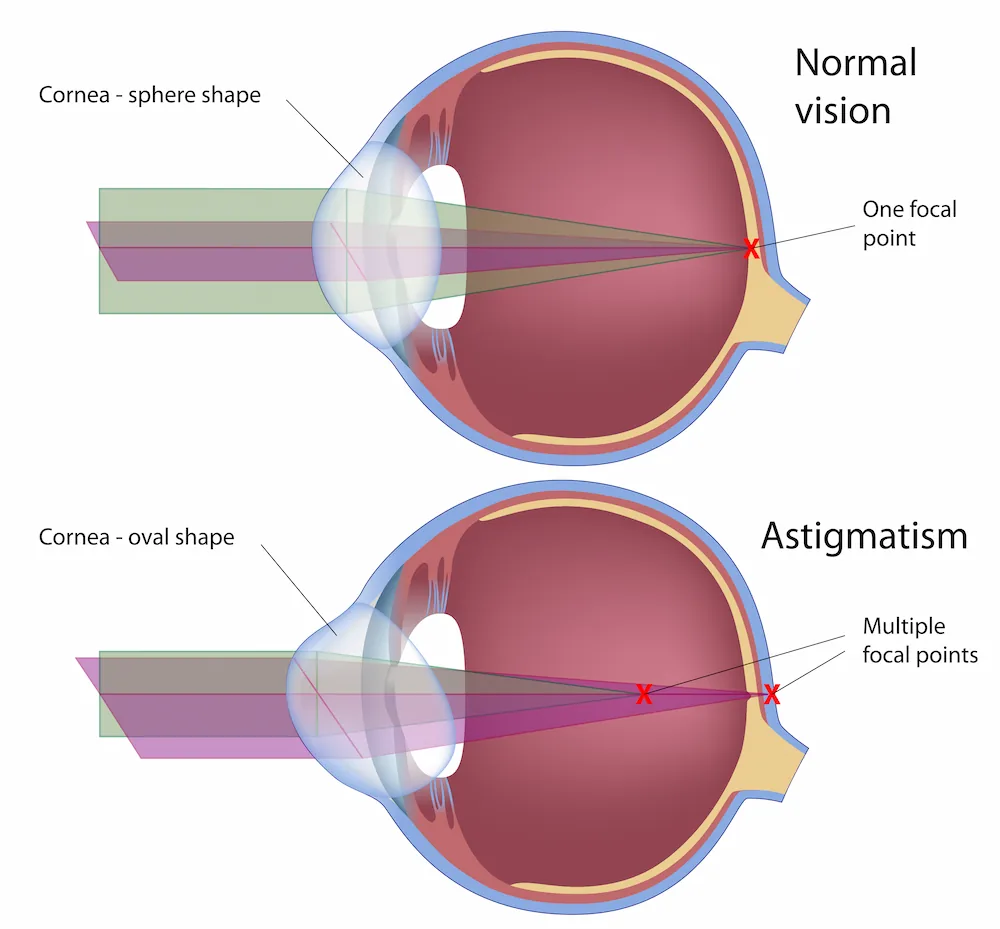
Astigmatism is one of the most common vision problems, affecting roughly one in three Americans. Understanding what it is can help you make informed decisions about your eye care.
Your eye is designed to focus light onto the retina, the light-sensitive tissue at the back of your eye. For clear vision, your cornea (the clear front surface of your eye) should be shaped like a basketball: smooth and evenly curved in all directions.
With astigmatism, your cornea is shaped more like a football, curved more steeply in one direction than another. This uneven curvature causes light to focus on multiple points instead of one, resulting in blurred or distorted vision at all distances.
Types of Astigmatism
There are two main types:
- Corneal astigmatism — The cornea has an irregular shape (most common)
- Lenticular astigmatism — The lens inside your eye has an irregular shape (less common)
Most people have a combination of astigmatism with myopia (nearsightedness) or hyperopia (farsightedness). A comprehensive eye exam is the only way to know for sure.
Common Symptoms of Astigmatism
If you have astigmatism, you might experience:
- Blurred or distorted vision at all distances
- Eye strain and fatigue, especially after reading or screen time
- Squinting to see clearly
- Headaches, particularly after visual tasks
- Difficulty with night driving due to glare or halos around lights
- Trouble focusing on fine details
Many people don’t realize they have astigmatism because they’ve adapted to blurred vision their entire lives. A comprehensive eye exam is essential to determine your vision needs.
How LASIK Corrects Astigmatism
LASIK (Laser-Assisted In Situ Keratomileusis) works by precisely reshaping your cornea using an excimer laser. Here’s how the procedure works:
The LASIK Procedure for Astigmatism
- Numbing drops are applied to your eye so you remain comfortable during the procedure
- A protective flap is created on the cornea’s surface using a femtosecond laser
- The excimer laser is programmed with your unique prescription and reshapes the corneal tissue beneath the flap
- The flap is repositioned, and your eye naturally heals without stitches
- The entire procedure takes about 15 minutes per eye
Why LASIK Works for Astigmatism
For astigmatism specifically, the laser removes more tissue from the steeper meridian of your cornea, gradually flattening it to create a more uniform, basketball-like shape. This allows light to focus on a single point on the retina, resulting in clear vision.
Our surgeons use advanced laser technology including wavefront-guided and topography-guided LASIK to map your cornea in incredible detail. This allows us to correct even complex astigmatism with exceptional precision.
Are You a Good Candidate for LASIK with Astigmatism?
Not everyone is a candidate for LASIK, but most people with astigmatism are. Here’s what we evaluate:
Your Astigmatism Is Within a Treatable Range
LASIK can typically correct astigmatism up to 5 to 6 diopters. Most people’s astigmatism falls well below this threshold, making them excellent candidates. During your vision consultation, we’ll measure your astigmatism precisely to determine if LASIK is right for you.
Your Prescription Is Stable
Your vision prescription should remain stable for at least 12 months before surgery. This is crucial because if your prescription is still changing, LASIK results may not be optimal. We’ll review your eye exam history to confirm stability.
You Have Healthy Corneas and Eyes
Your corneas must be thick enough to safely reshape. We use advanced imaging to measure corneal thickness and map the corneal surface. You should also be free from:
- Keratoconus (progressive corneal thinning)
- Severe dry eye syndrome
- Active eye infections or inflammation
- Certain retinal conditions
You’re Age 18 or Older with Adult Vision
Your eyes should be fully developed, which typically occurs by age 18. We also prefer that your vision has been stable for at least one year.
Additional Considerations
- Pregnancy — We recommend waiting until after pregnancy and breastfeeding, as hormonal changes can affect vision
- Certain medications — Some medications can affect healing; we’ll review your medical history
- Occupational demands — If your job requires excellent uncorrected vision, LASIK is an excellent choice
The Benefits of LASIK for Astigmatism
Clear Vision at All Distances
Unlike glasses or contacts that may not fully correct astigmatism, LASIK provides crisp, clear vision at near, intermediate, and far distances for most patients.
Permanent Results
LASIK results are permanent. Your cornea won’t return to its original shape. While your eyes may change with age (presbyopia after age 40), the astigmatism correction remains stable.
Freedom from Glasses and Contacts
Imagine waking up and seeing clearly without reaching for your glasses. No more:
- Searching for lost contacts
- Dealing with dry, irritated eyes from contact lens wear
- Paying for glasses and contact lens replacements
- Worrying about glasses fogging up or breaking
Quick Recovery and Minimal Discomfort
- Vision improvement begins within 24 hours
- Functional vision is typically achieved within 3 to 7 days
- Full healing occurs within 3 to 6 months
- Minimal discomfort — most patients describe only mild discomfort during the procedure
High Success Rates
Studies show that up to 90% of LASIK patients achieve 20/20 or better vision, and more than 98% of patients report being satisfied or very satisfied with their results.
LASIK vs. Other Astigmatism Correction Methods
PRK (Photorefractive Keratectomy)
PRK is similar to LASIK but doesn’t involve creating a corneal flap. Instead, the outer layer of the cornea is gently removed. PRK may be recommended if you have thin corneas or certain corneal conditions.
Pros: Works for thinner corneas; no flap complications
Cons: Longer recovery time (1 to 4 weeks); more initial discomfort
Toric Contact Lenses or Glasses
Traditional correction methods work but require ongoing maintenance and expense.
Pros: Non-surgical; reversible
Cons: Daily hassle; ongoing costs; may not fully correct astigmatism
For most patients with astigmatism, LASIK offers the best combination of effectiveness, safety, and long-term value.
What to Expect: Before, During, and After LASIK
Before Surgery
- Comprehensive eye exam — We’ll measure your vision, corneal thickness, and corneal shape
- Discuss your goals — We’ll review realistic outcomes and answer all your questions
- Arrange transportation — You’ll need a ride home; you can’t drive immediately after surgery
- Stop contact lens wear — We’ll ask you to stop wearing contacts 1 to 2 weeks before surgery to allow your cornea to return to its natural shape
During Surgery
- The procedure takes about 15 minutes per eye
- You’ll be awake but comfortable with numbing drops
- You may feel slight pressure but no pain
- You’ll see a red light during the laser reshaping—this is normal
After Surgery
First 24 Hours:
- Vision will be blurry initially but improves rapidly
- Mild discomfort, grittiness, or tearing is normal
- Use prescribed eye drops frequently
- Avoid rubbing your eyes
- Rest and keep your eyes closed when possible
First Week:
- Most patients achieve functional vision within 3 to 7 days
- Continue using prescribed drops
- Avoid strenuous exercise, swimming, and hot tubs
- Wear sunglasses outdoors to protect your eyes
First Month:
- Avoid contact sports and activities that could impact your eyes
- Continue using drops as directed
- Attend all follow-up appointments
- Vision continues to stabilize
3 to 6 Months:
- Full healing and stabilization occurs
- Most patients can resume all normal activities
- Final vision results are typically achieved
Addressing Common Myths About LASIK and Astigmatism
Myth #1: “LASIK doesn’t work for astigmatism”
Fact: Modern LASIK effectively corrects astigmatism in most cases. Advanced laser technology can precisely reshape the cornea to correct even complex astigmatism.
Myth #2: “LASIK results don’t last”
Fact: LASIK results are permanent. Your cornea won’t return to its original shape. While your eyes may change with age (presbyopia), the astigmatism correction remains stable.
Myth #3: “LASIK is painful”
Fact: LASIK is painless during the procedure thanks to numbing drops. You may feel slight pressure, but no pain. Some mild discomfort in the first 24 hours is normal and manageable with prescribed drops.
Myth #4: “Recovery takes months”
Fact: Most patients achieve functional vision within 3 to 7 days. While full healing takes 3 to 6 months, you can return to most normal activities much sooner.
Myth #5: “LASIK is expensive”
Fact: While LASIK requires an upfront investment, most patients save money within 5 to 10 years compared to ongoing costs of glasses and contacts. We offer financing options to make LASIK accessible.
Success Rates and Patient Satisfaction
The data speaks for itself:
- Up to 90% of LASIK patients achieve 20/20 or better vision
- More than 98% of patients report being satisfied or very satisfied
- Fewer than 1% of LASIK patients experience any complications
- Long-term studies show stable results 10+ years after surgery
These impressive statistics apply to patients with astigmatism just as much as those with other refractive errors.
Potential Complications and Side Effects
While LASIK is safe, like any surgical procedure, it carries some risks. Most are temporary and minor:
Common Temporary Side Effects (Usually Resolve Within 3 to 6 Months)
- Dry eyes
- Glare or halos around lights, especially at night
- Slight over- or under-correction
- Fluctuating vision during healing
Rare Complications
- Corneal ectasia (progressive corneal weakening) — extremely rare with modern screening
- Infection: very rare with proper post-operative care
- Flap complications: uncommon with modern femtosecond lasers
- Undercorrection or overcorrection requiring enhancement
During your vision consultation, we’ll discuss your individual risk factors and how our advanced technology and careful patient selection minimize complications.
Cost and Financing Options
LASIK costs vary based on the complexity of your prescription and the technology used. At Southern Eye Group, we offer:
- Transparent pricing with no hidden fees
- Flexible financing plans with monthly payments as low as $188
- HSA/FSA acceptance
- Exploration of insurance coverage options
Many patients find that LASIK pays for itself within 5 to 10 years when compared to the ongoing costs of glasses, contacts, and eye exams.
Frequently Asked Questions
How long does LASIK take?
The actual laser time is only 20 to 40 seconds per eye. The entire procedure, including preparation, takes about 15 minutes per eye.
When can I return to work?
Most patients can return to desk work within 3 to 5 days. If your job involves physical labor or dusty environments, wait 1 to 2 weeks.
Can LASIK be done on both eyes the same day?
Yes, we typically perform LASIK on both eyes during the same appointment, though some patients prefer to wait a day between eyes.
What if my vision changes after LASIK?
If your vision regresses slightly over time, we can perform an enhancement procedure. However, most patients maintain stable vision for 10+ years.
Can I get LASIK if I have astigmatism and presbyopia?
Yes, but we may recommend monovision LASIK, where one eye is corrected for distance and the other for near vision. This requires a consultation to determine if it’s right for you.
Is LASIK covered by insurance?
Most insurance plans don’t cover LASIK since it’s considered elective. However, some plans offer discounts through partner networks. We can help you explore your options.
Ready to See Clearly? Schedule Your Vision Consultation Today
If you’ve been living with astigmatism and wondering if LASIK is right for you, the answer is likely yes. The doctors at Southern Eye Group have helped patients throughout Alabama, Florida, and Mississippi achieve the clear vision they’ve always wanted.
Don’t let astigmatism hold you back. Schedule your vision consultation with Southern Eye Group today. During your visit, we’ll:
- Perform advanced eye imaging to assess your candidacy
- Discuss your vision goals and expectations
- Answer all your questions
- Explain your financing options
- Help you take the first step toward clear vision
Contact Southern Eye Group now to book your appointment. Clear vision is closer than you think.
Sources:
- Dupps WJ Jr. LASIK outcomes: How are we doing and can we do better? J Cataract Refract Surg. 2016 Aug;42(8):1109-10. doi: 10.1016/j.jcrs.2016.07.017. PMID: 27531283.
- American Refractive Surgery Council. Is LASIK Safe? What You Need to Know. Available at: https://americanrefractivesurgerycouncil.org/lasik-safe-need-know/.